Showing posts with label workshop. Show all posts

Feb 16, 2015

Mjolnir

Unlike Mjolnir, my mighty hammer was not forged by dwarven brothers. Nor does it have a short handle. And it doesn't have the power to level mountains. So perhaps it is nothing like the fabled weapon of the thunder god, but I made it and that counts for something, right? I based my plans off of Steve Ramsay's "Thor's Hammer" on Woodworking for Mere Mortals.

I started with a board I found in the 'exotic cutoffs' bin at Woodcraft. I'm fairly certain it is walnut but I don't know for sure. It is pretty rough on one face, probably from the saw at the mill.
Starting board.
I cut a piece to 2 1/2" wide. The board was about 7" wide which is a bit wider than I want but leave me room to make mistakes. I next cut the cavities in the inner pieces. I don't have a drill press nor do I have a Forstner bit to cut large holes like Steve does so I improvised and used a smaller paddle bit and my jigsaw to finish them off.

About 7" x 2 1/2" x 3/4".

After drilling holes.

And finished with jigsaw.
These cavities will be where the real weight of the hammer will be: fishing sinkers. I cut these end pieces off at a 2° angle to held make a wedge where the handle will go. I also cut two more piece at about 6" for the sides.

Slight angle between the inner pieces.

All pieces for the head.
I glued the inner pieces to one side piece first. Using the other side piece on top, but not glued down, to provide a clamping surface I let the glue set up before adding my weights. I managed to get quite a few into the cavities but you can still here some movement when shaking the hammer. I then glued the other side on and worked on the handle while I waited for that glue to set.

Gluing the inner pieces to one side.

Lots of weight added.
I followed Steve's process on creating a simple tenoning jig out of some 2x4 stock I had lying around. It probably isn't the most accurate jig but it gets the job done for this project. I used a scrap of purpleheart I had left over from the table saw sleds I made some time ago.

Using the tenoning jig.
I then cut the wedges for fastening the handle into the head of the mallet. These were cut from the walnut board I had and were also cut at a 2° angle. Because I wasn't very accurate with my tenoning jig I had to make wedges of various sizes.

Wedges and handle.

Head glued up.
To add a little style to the head and comfort to the handle I tilted my table saw to a 20° angle and trimmed off the corners of both parts. I ran the handle through in different orientations to smooth out any hard corners. Afterwards I put it all together by gluing the wedges into the top of the mallet head in between the handle's tenons. I coaxed these in with my regular hammer to ensure a snug fit. I let the glue set up and then cut the excess off with my Japanese razor saw.

Added wedges.

Trimmed down.

Finished with boiled linseed oil.
After a bit of sanding to smooth out the top and then some finish sanding to smooth out the handled I applied a coat of boiled linseed oil which I can renew as needed. I do plan to add leather patches to both sides of the mallet head to help protect my work pieces. I do need to practice my tenoning as the mallet head doesn't quite sit right on the shoulder cuts of the handle. Being a shop project I wasn't concerned with the woods used but I noticed that the walnut and purpleheart don't really compliment each other very well. Overall I'm quite pleased with the end result and look forward to using it in the shop.

Aug 29, 2014

Workshop Update

With the table saw now in place (see A Growing Workshop) I need to add some more storage and clear up the little available floor space I have in my workshop. I picked up a few old kitchen wall cabinets from my local ReStore as well as a scrap of peg board. I also managed to find a 2x2 furring strip to fit nicely behind the pegboard to stand it away from the wall so that I can use peg hooks and such. I was able to cut four pieces from this 2x2 for mounting the pegboard and I placed them vertically and evenly spaced on the wall. They provide a strong frame to mount the pegboard to.

Here is my new (to me) table saw and the wall cabinets and peg board.

Another angle of the slightly more organized workshop.


Another angle. You can see how crowded it is with the saw
now set up in the center.
The table saw will be nice to have and I have been thinking of moving the miter saw and bench out to the garage for projects that don't require quite as much precision as the furniture making I will be doing in the basement. This would free up some space and allow me to build an outfeed table for the Ridgid saw allowing me to cut larger panels than the 2'x4' project panels I've been using. I spent some time cleaning the surface of the table saw with some WD-40 and a green scrubbing pad to remove the small amounts of rust on it. I also cleaned and lubricated the threaded rods used for adjusting the bevel and blade height. This made both of those functions much smoother. I also took the time and ensured the bevel angles were set properly on the guide. All I needed was my carpenter's square to ensure vertical and 45 degree angles. I found that the hand wheels used to adjust the blade were both cracked and so I epoxied the inner flanged nut in the wheel to seal up the cracks and prevent the nut from slipping in the wheel when I turn it. This works for now but I would like to eventually replace the plastic wheels with some aluminum ones. With that being said, I am looking forward to my next project of building a Kallax-like bookshelf for our office. And Siri also found us something to work on afterwards:

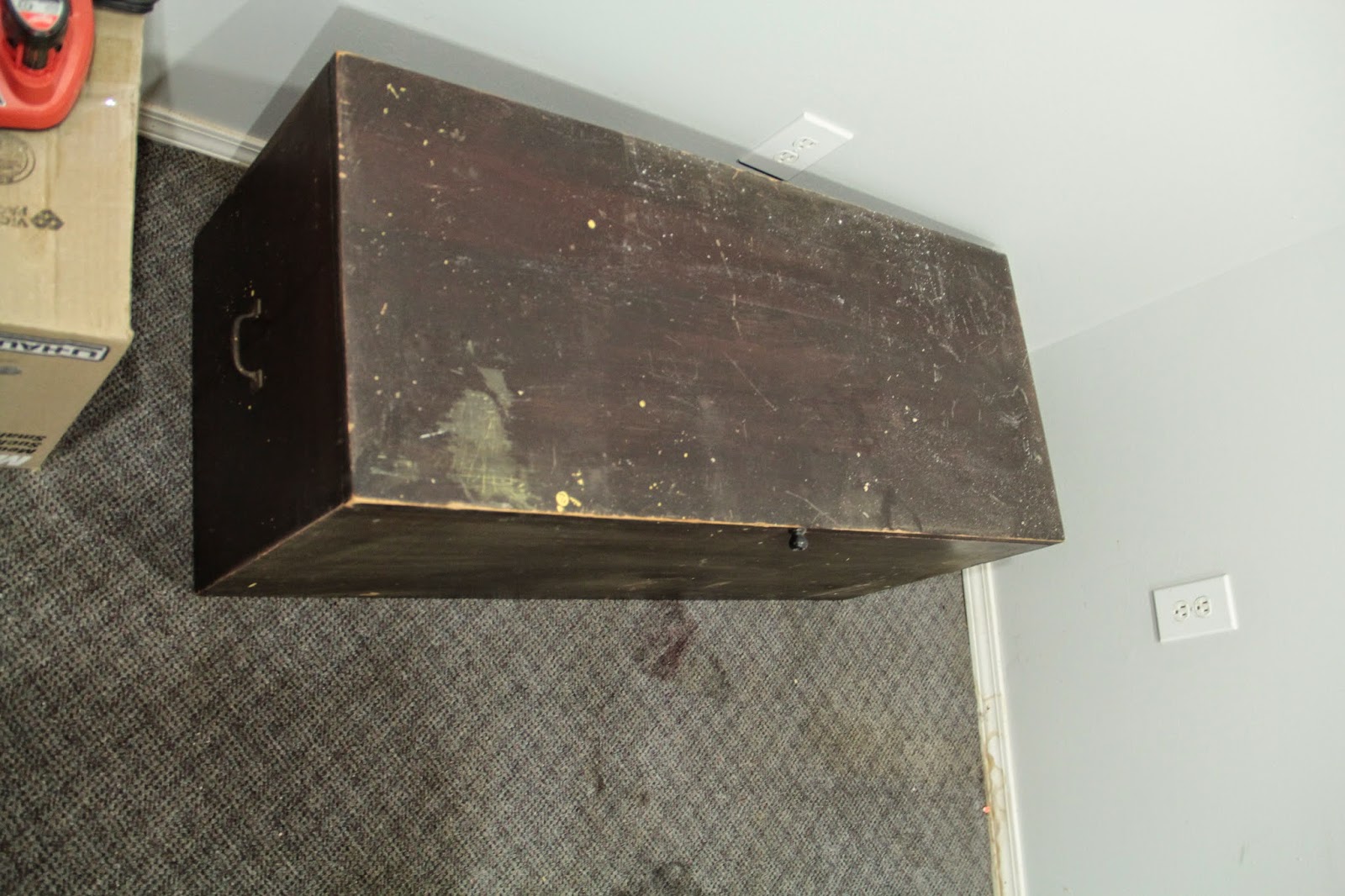
A nice pine chest from ReStore.
It needs some cleaning.
We collected this piece at ReStore for a bargain. I want to use my new random orbital sander to take the current paint off and remove any small blemishes. I think we are going to paint it white and try to add some distress effects to it to give it a nice antique look. I'll be posting plans and pictures of the bookshelf build first and then expect an update on the chest.


Aug 22, 2014

A Growing Workshop

As I build larger and more complicated pieces, I need to grow my tool repository. All of the work I've done up to this point has been accomplished with a basic set: a low powered Black & Decker drill, a hand saw, a miter saw, a hammer, screw drivers, a dowel jig, a circular saw, and a few clamps. I picked up a Rigid 2412 table saw, similar to the one pictured below, off of Craigslist.

My model table saw (minus the rust).
My buddy John helped me carry it down to the workshop last night and I still have to bolt it together and tune it up. I plan to follow this guide from Wood Magazine to tune it and hopefully get some good results. I would like it to be as accurate as possible since I don't have a jointer to create clean surfaces for edge gluing panels and I will be using this saw to fill that role. I'll eventually build an outfeed table for larger boards but I should be able to manage a few projects without one.

The next project is going to be a bookshelf similar to the Kallax series from IKEA. I will be using the table saw to create dados and rabbet joints for the piece. I plan to make it from a veneer plywood and dress the plywood ends with some moulding.

The next tool I will likely get is a router. I'd like to find one that is robust enough to be used both in a table and freehand but still for a reasonable price. I'll probably return to Craigslist or find a refurbished one from one of the CPO outlets. If you haven't heard of CPO they are a reconditioned tools outlet and they have an enormous selection at great prices. I found a Rigid 5" random orbit sander for half of the cost of a new one.

Now where to keep all of these things? ReStore to the rescue! ReStore is run by Habitat for Humanity and carries donated items from many places including home remodeling projects. I plan to pick up some wall cabinets from one of their locations to store many of my supplies and tools. Since I have a small workshop (about 10' x 12') I have to make good use of my wall space. Any other floor or bench tools I get will have to be put on mobile bases so that I can move them around as I work with larger timbers and sheets of plywood.

Work safe!

Aug 11, 2014

Let's Build a Workbench

I've been building a vanity for the girlfriend and all of my work has had to happen on the floor. Well no longer! Today I built myself a basic workbench out of some 2x4s and MDF. It is a basic design but is quite sturdy. Here's how I did it:
Here I am making the legs with two 2x4s I laminated together.

I put them together with 2 1/2" screws...

...and a bit of wood glue.

The completed legs are 40" tall. A good standing height for me.

I built the side frames by connecting two legs with 18" boards.

And just copied it for the other side.

Attaching the side frames with 46" long boards.

Front and back done.

Standing up. I will have to fashion some way to level it on my uneven floor.
I added a cross beam for supporting the top surface.

I used 3/4" MDF for the top. It is strong and I won't mind
screwing into it or ruining it. It is sacrificial.

First use! I am using the workbench to complete the workbench.
I clamped a 1/2" MDF panel down to cut it for the bottom shelf.

I had to cut it to fit width and depth as well as cutting notches
to accommodate the legs.

All done! Miter saw fits nicely on top.

And cleaned up the workshop.
Most of the bench was put together with some wood glue and then 2 1/2" screws. The MDF panels were 2'x4' and attached with 1 1/4" screws. The top panel was not cut and overhangs on the front and sides. It is flush with the back of the bench since it will be placed against a wall. I haven't yet decided if I will mount it to the wall for stability or keep is somewhat mobile. The frame was built using 7 2"x4"x8' pine boards. I used my miter saw for the framing cuts and a circular saw for the MDF. The MDF creates a very fine dust when cut so be sure to wear good respiratory protection. I will be investing in a new respirator as I found that my glasses and safety glasses fog up after 4 or 5 breathes with the disposable masks.